


Post-marathon recovery: the autumn runner’s guide to joint and tendon repair
Crossing the finish line is the end of the marathon. It is not the end of what your body is doing. After 26.2 miles, muscles are recovering from an unusually high workload, energy stores need replacing and the tendons and joints that absorbed thousands of loading cycles need time before they are asked to do it all again. Research after marathon running has found measurable changes in muscle, inflammatory, cartilage and Achilles tendon markers in the hours following a race.
That is why post-marathon recovery is more than waiting for your legs to stop aching. At Perfect Balance, we think of it as a transition between one training cycle and the next. The aim is not to keep you inactive for an arbitrary number of days. The process should move from recovery into gradual loading, with each step informed by how you are actually responding.
For many runners, that process is straightforward. For others, the marathon exposes an Achilles that had been grumbling through the final weeks of training, a knee that becomes increasingly irritable once the general soreness fades, or a particular area that simply does not behave like normal post-race stiffness. If the problem is becoming more specific rather than settling, particularly if it changes your walking, it is sensible to understand what is happening before loading up your running again.
Why marathon recovery is about more than sore muscles
The first morning after a marathon can make an ordinary staircase feel surprisingly ambitious. That widespread stiffness is familiar, but the recovery taking place underneath it is more complex.
Marathon research has documented a clear short-term physiological response, including increases in markers linked to muscle stress and inflammation. Importantly, different tissues do not necessarily recover at the same rate. Feeling less sore therefore does not automatically mean every part of the body is ready for normal training.
The Achilles tendon gives us a useful example. A study of London Marathon runners found an immediate reduction in Achilles tendon thickness after the race, thought to reflect the tendon’s response to prolonged mechanical loading. The finding does not mean that every marathon damages the Achilles. It does show that the tendon responds measurably to the demands of the event, even when pain is absent.
There is a similar need for perspective when we talk about joints. Marathon running can temporarily alter markers related to cartilage metabolism and inflammation, but these findings should not be translated into the simplistic idea that running a marathon automatically “wears out” your knees. In one study of recreational marathon runners, changes in cartilage-related biomarkers included increased markers of type II collagen synthesis rather than a straightforward picture of cartilage breakdown.
Recovery, then, is not about repairing a body that has somehow been broken by running. It is about allowing normal biological recovery and adaptation to catch up with an exceptional amount of load.

The first 72 hours: make recovery deliberately easy
One of the hardest parts of a good post-marathon recovery plan is accepting how little needs to be achieved immediately afterwards.
You have already done the hard session.
In the hours after finishing, gentle walking can be useful before you settle down completely. Restoring energy and fluids is another important part of recovery. Sports nutrition guidance places carbohydrate, protein, fluid and electrolyte replacement at the centre of recovery after prolonged exercise, while current post-marathon advice also recommends giving the body time before returning to running.
A simple post-marathon recovery routine for the first few days might include:
gentle walking and normal day-to-day movement as comfort allows
regular meals containing carbohydrate and a good protein source
replacing fluid and salts lost through sweat
prioritising sleep and allowing extra rest where needed
avoiding the temptation to test your legs with a hard run because they suddenly feel better on day two or three
Soreness commonly becomes more noticeable after the immediate excitement of race day has passed, so the morning after the marathon is not always a good guide to how the second or third day will feel.
There is also no prize for collecting recovery treatments. Massage, compression, cold water, mobility work and other approaches may feel useful to some runners, but none replaces the basics of sleep, nutrition, appropriate movement and time. Recovery should not become another training session that you feel obliged to complete.

Days four to fourteen: let your body set the pace
Many post-marathon recovery running plans work on a “reverse taper” principle. Training volume drops dramatically after the race and is then rebuilt rather than being switched straight back on. Established marathon programmes use variations of this approach, although the exact timetable differs between runners.
At Perfect Balance, we would rather look at readiness than simply count calendar days.
Imagine two runners seven days after the same race. One is walking normally, has no swelling, feels comfortable on stairs and notices only mild general stiffness. The other has developed a distinct pain beneath the kneecap every time the leg is loaded. Giving both runners the same instruction because it is “day seven” misses the point.
When easy running returns, it should feel like a reintroduction rather than a fitness test. Start shorter and easier than your pre-marathon training instincts might suggest. Flat, relaxed running is easier to interpret than hills, intervals or a long run. What happens afterwards matters too. A run that feels comfortable at the time but leaves a tendon noticeably more painful or stiff the following morning is useful information.
Return-to-running literature increasingly treats progression as a staged process rather than a simple date on the calendar, taking account of tissue capacity, running demands and the individual athlete rather than relying on mileage alone.
Your breathing and general fitness may feel normal again while your legs still feel some way behind. That mismatch can be deceptive. Being aerobically capable of running hard does not necessarily mean the tissues that have just completed a marathon need that load yet.
Tendons respond to load, so recovery is not the same as complete rest
The Achilles and patellar tendons are particularly relevant to runners because they repeatedly transmit substantial forces between muscle and bone. After months of marathon training, they have already accumulated a long history of load before race day even begins.
Some temporary stiffness can occur as part of recovery, so the pattern matters more than the symptom in isolation. What matters is the pattern.
A tendon that becomes increasingly localised in its pain, is repeatedly stiff after rest, becomes less tolerant of running or continues to deteriorate as general marathon soreness disappears deserves closer attention. The mistake is often at one of two extremes: ignoring it and continuing to run normally, or becoming frightened of loading the tendon at all.
For established Achilles tendinopathy, evidence-based guidelines favour active treatment built around education, load management and progressive calf strengthening. Full sporting demands come later in the process, once tendon capacity has been rebuilt gradually over time.
That is quite different from routine post-marathon soreness.
At Perfect Balance Clinic, this distinction matters. An assessment is not simply about finding the painful spot. We may look at how the symptoms began, how they behave after loading, calf or quadriceps capacity, previous injuries, recent training changes and the movement demands of running. Where appropriate, running or gait assessment can add another part of the picture.
The goal is to work out what the tissue can currently tolerate, then build from there.

What about your knees and other joints?
Post-marathon knees can feel stiff, heavy or generally irritated without there being significant joint injury. Running exposes the knee to repeated load, but cartilage is living tissue and its response to exercise is more complicated than the idea of mileage simply grinding it away.
Research examining cartilage biomarkers after marathon running has demonstrated temporary biological changes rather than a uniform pattern of tissue deterioration. Other MRI research on running has similarly shown that cartilage can deform under load and then recover afterwards.
Symptoms still matter. A swollen knee, repeated giving way, locking, inability to bear weight comfortably or pain that is becoming more rather than less pronounced should not simply be filed under “post-marathon aches”.
The same applies to focal pain over a particular bone or joint. Generalised tired legs usually become easier to live with as recovery progresses. A very specific problem that starts dominating your movement deserves a different level of attention.
This is where clinical reasoning earns its place. The question is not simply, “Does my knee hurt after a marathon?” It is, “What is this particular pain doing, and does its behaviour fit the recovery we would expect?”
Post-marathon recovery food is part of tissue recovery
After months of structured training, some runners finish their marathon and immediately switch from performance nutrition to eating less because their mileage has dropped.
Recovery is not the ideal moment to underfuel.
Carbohydrate helps restore the glycogen used during prolonged running. The body uses amino acids from protein as part of the rebuilding process after strenuous exercise. Fluids and electrolytes replace what has been lost through sweat. Sports nutrition consensus guidance therefore treats adequate energy, carbohydrate, protein and hydration as part of recovery rather than something separate from it.
Post-marathon eating can stay practical, familiar and easy to manage. A substantial meal containing rice, pasta, potatoes or another carbohydrate source alongside eggs, fish, meat, dairy, tofu, pulses or another protein source can do the job perfectly well. Fruit, vegetables and normal sources of dietary fat bring the wider nutritional picture with them. If appetite is poor immediately after the race, something easier to tolerate can bridge the gap until a fuller meal sounds appealing.
The important point is consistency over the following days. One recovery shake cannot compensate for repeatedly eating too little while the body is trying to restore energy and rebuild.
And recovery food is still food. Unless there is a specific nutritional reason to do otherwise, there is no need to turn the week after a marathon into a supplement protocol.
Tendon repair after a rupture is a completely different pathway
The word “repair” causes some confusion online because it can describe two very different things.
In routine post-marathon recovery, we are talking about the body’s normal recovery and remodelling after exercise. A tendon rupture is an acute structural injury. Surgical tendon repair involves bringing damaged or torn tendon ends back together, sometimes with additional reconstruction when the injury is more complex.
That distinction is particularly important if you are searching for an Achilles tendon repair protocol. An Achilles rupture may involve a sudden pop or snap, severe pain around the heel and a marked loss of normal push-off function. It needs prompt medical assessment rather than an ordinary post-marathon recovery programme.
Likewise, a patellar tendon repair rehab protocol or quad tendon repair rehab protocol refers to rehabilitation after a significant knee tendon injury and, in many cases, surgery. These pathways involve carefully staged protection, movement and strengthening under the direction of the surgical and rehabilitation team. They should not be confused with managing a sore patellar or quadriceps tendon after a race.
If you have undergone tendon surgery, your surgeon’s protocol takes priority over generic running advice. The speed at which movement, strengthening and running return depends on the exact injury, procedure, healing progress and individual circumstances.
The best post-marathon recovery plan prepares you for what comes next
A good recovery should gradually make your options bigger.
At first, success might mean walking downstairs without holding the banister. A few days later, it may be an easy cycle or comfortable walk. Then perhaps a short run that feels uneventful during the session and still feels uneventful the following morning.
That progression is far more useful than chasing the earliest possible date to start running again.
It is also worth remembering the mental side of the process. Marathon training gives your week structure for months. Once the race is over, some runners are desperate to enter the next event simply because the empty space feels strange. There is nothing wrong with having another goal, but recovery does not have to be rushed to create one.
At Perfect Balance, we want runners to come out of a marathon block understanding their bodies better than when they went into it. If the race exposed an Achilles issue, recurring knee pain, a strength deficit or a pattern that kept appearing during training, the quieter weeks afterwards are a useful opportunity to address it before the next block begins.
When a post-marathon assessment may be useful
Most runners do not need treatment simply because they have completed a marathon. Recovery is expected.
Assessment becomes more useful when the pattern stops looking like ordinary recovery. That might include pain becoming more localised or intense, persistent swelling, a new limp, repeated Achilles stiffness, knee symptoms that are not settling, difficulty returning to easy running or an old problem that has resurfaced once the race is over.
You may also feel physically comfortable but be unsure how to rebuild towards your next goal. In that situation, the conversation is less about “fixing” something and more about understanding current capacity and planning the next stage properly.
Perfect Balance clinicians can assess the problem in the context of your training, your movement and what you want to return to. From there, physiotherapy or sports therapy can be used where appropriate to build a clearer route back to normal training. Gait analysis may also be useful when understanding running mechanics forms part of that clinical question.
Service availability: Physiotherapy and Sports Therapy are available at Lord’s Cricket Ground (St John’s Wood), Hatfield, St Albans, Moorgate, Bath, Cobham and Cambridge. Gait Analysis is available at Hatfield, St Albans, Moorgate and Cambridge.
If your marathon is finished but one part of your body does not seem to be recovering with the rest of you, contact Perfect Balance Clinic. We can help you understand what is happening, decide what needs attention and build a recovery plan around where you want your running to go next.
Perfect Balance Clinic Locations
You might also find useful
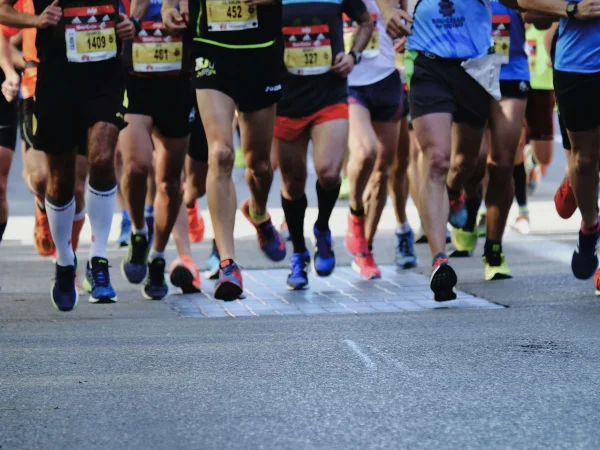
Post-marathon recovery: the autumn runner’s guide to joint and tendon repair

Research disclosure
This article was supplemented with additional external research. Sources used include:
Scott I, Malliaras P, Tardioli A, Hales S, Morrissey D, Migliorini F, Maffulli N.
Achilles tendon thickness reduces immediately after a marathon.
Journal of Orthopaedic Surgery and Research, 2022; 17(1):562.
https://doi.org/10.1186/s13018-022-03448-z
Hernández-Hermoso JA, Nescolarde L, Roca E, Revuelta-López E, Ara J, Bayes-Genis A.
Marathon Running Increases Synthesis and Decreases Catabolism of Joint Cartilage Type II Collagen Accompanied by High-Energy Demands and an Inflamatory Reaction.
Frontiers in Physiology, 2021; 12:722718.
https://doi.org/10.3389/fphys.2021.722718
de Vos R-J, van der Vlist AC, Zwerver J, et al.
Dutch multidisciplinary guideline on Achilles tendinopathy.
British Journal of Sports Medicine, 2021; 55(20):1125–1134.
https://doi.org/10.1136/bjsports-2020-103867
Hegedus EJ, Ickes L, Jakobs F, Ford KR, Smoliga JM.
Comprehensive Return to Competitive Distance Running: A Clinical Commentary.
Sports Medicine, 2021; 51(12):2507–2523.
https://doi.org/10.1007/s40279-021-01547-1
Thomas DT, Erdman KA, Burke LM.
American College of Sports Medicine Joint Position Statement. Nutrition and Athletic Performance.
Medicine & Science in Sports & Exercise, 2016; 48(3):543–568.
https://doi.org/10.1249/MSS.0000000000000852

Written by Kevin Paul Medina
A content writer with experience creating clear and easy-to-understand material for Perfect Balance. I have worked on a range of articles across physiotherapy and osteopathy topics, focusing on readability and helping present information in a structured and accessible way. My role involves working closely with clinical input to ensure content is accurate and suitable for its intended audience.
Expert review by Keone Parker
Last updated 23rd September 2026